
My Research Journey
I am a Postdoctoral College Fellow in the Committee on Degrees in Social Studies at Harvard University. I hold a Ph.D. in Sociology from Harvard University and a Master of Public Policy from the University of Southern California. My work focuses on race, ethnicity, and immigration in the United States, with particular attention to Latino populations. I study how groups are formed, how social boundaries are drawn and reshaped, and how race is defined and redefined over time. As a social demographer, I use advanced quantitative methods to examine how inequality is produced and reproduced across multiple domains of social life, with implications for both scholarship and public policy.
My work has been published in leading sociological outlets such as Socius and International Migration Review, and my scholarship has received awards from the American Sociological Association’s sections on Population, Latina/o Sociology, and International Migration.
Research Projects & Publications
Latino Ethnoracial Boundaries: State Classifications vs. Everyday Identifications
Scholarship posits that the state is the most powerful actor in “race-making” via its institutionalization of racial categories, especially through national censuses. Yet whether census ethnoracial categories correspond to experientially existing social groups crafted through everyday boundary making is an empirical question. When census categories misalign with micro-level boundaries, inferences drawn from census data may seriously misrepresent intergroup relations. Using unique, multidimensional data on self-classified Hispanics in the United States, I estimate the degree and correlates of (mis)alignment between Hispanics’ racial self-classifications on a closed-ended, census-style race question and their racial self-identification on an open-ended question. I find substantial misalignment between racial self-classification and self-identification, with self-rated skin tone and reflected appraisal particularly important for white (mis)alignment, and immigrant generation status strongly associated with use of hyphenated American identifications. I conclude that although the state exhibits “race-making” power, reliance on census race categories alone misrepresents Hispanics’ ethnoracial boundary making practices, distorting inferences about the larger U.S. racial structure. Including a Hispanic option on the census race question improves overlap between state and everyday racial categories, but a Hispanic racial self-identification is by no means a universal convention.
Latino Intermarriage, Ethnic Attrition, and the Future of U.S. Ethnoracial Boundaries
Many people in the United States with Latin American ancestry do not identify as Latine, a social phenomenon known as ethnic attrition. Ethnic attrition is a form of identificational assimilation in which attachments to Latine ethnicity erode and give way to other ethnoracial identifications. Canonical “straight-line” assimilation theory, on which most extant Latine ethnic attrition research relies, interprets attrition as evidence of ethnoracial boundary blurring driven primarily by intermarriage with non-Latines. In contrast, racialized assimilation theory conceptualizes attrition as boundary crossing, in which racialization structures whether individuals with Latin American ancestry retain a Latine racial identity or exit the category altogether. Using pooled 2008–2019 American Community Survey data, I estimate the prevalence and correlates of parent-appraised ethnic attrition among children with Latin American ancestry, adjudicating between these frameworks by modeling the joint effects of intermarriage and racial categorization. I find that intermarriage and racial categorization are each necessary but insufficient to produce attrition; instead, attrition is concentrated among children who meet the dual conditions of having intermarried parents and not being categorized as racially Latine. Moreover, the intermarriage–attrition association is sharply stratified by race, with Black-classified children of intermarriage exhibiting the highest probability of attrition and multiracial-classified children the lowest. These findings suggest that ethnic attrition reflects elements of both straight-line and racialized assimilation. However, rather than signaling wholesale absorption into the other groups, attrition appears limited in scope, implying erosion at the margins rather than the dissolution of Latine ethnoracial boundaries.
Reconceptualizing Latino Ethnoraciality along a Symbolic-Consequential Continuum
How should sociologists diagnose ethnoracial boundary change amid rapid demographic transformation? Research on Latino/non-Latino boundaries has largely relied on categorical measures of self-identification, treating ethnic attrition as evidence of boundary blurring. Yet categorical mobility alone cannot determine whether the lived structuring force of identity has meaningfully attenuated. This study integrates categorical and gradational approaches to ethnic identity by developing a multidimensional symbolic–consequential ethnicity continuum that captures the extent to which Latino identity shapes social life across domains of external imposition, cultural practice, and social embeddedness. I compare ethnic consequentiality across three ancestry-identification groups: exclusive-ancestry Latinos, mixed-ancestry Latinos who retain a Latino identification, and ethnic attritors. Ethnic attritors are concentrated on the symbolic end of the continuum, while mixed-ancestry identifiers more closely resemble exclusive-ancestry Latinos and overlap extensively with them in the distribution of ethnic consequentiality. These findings indicate that categorical exit corresponds to substantial thinning in lived ethnicity, but that consequential attachments remain durable for most mixed-ancestry Latinos. Boundary change, therefore, does not unfold mechanically through ethnoracial mixing or category crossing alone. By linking identificational mobility to graded shifts in ethnic consequentiality, this study advances a generalizable framework for evaluating when categorical movement signals substantive ethnoracial transformation and when it does not.
Transnational Social Stratification: U.S. Immigration Policy Affects Mexican Society
Although there is evidence documenting the impacts of Mexican parents’ migration to the United States on the educational attainment of the children they leave behind, the potential role of parents’ legal status in stratifying their children’s educational achievement is poorly understood. Using data from the Mexican Migration Project, I estimate the educational effects of parents’ documentation status for the children left behind in Mexico. I utilize coarsened exact matching and entropy balancing, alongside community fixed effects, in a counterfactual regression framework to address the endogeneity of parental migration decisions. I find that parental migration’s effectiveness as a mechanism for securing educational gains among children left in Mexico differs by parents’ legal status. Documentation allows migrant parents to translate their experiences in the United States into relatively greater educational achievement for their children in Mexico. In the post-1986 period, the non-immigrant children of undocumented parents experienced a significant education penalty. These findings elucidate the effect of US immigration policy on social stratification in Mexican society.
Social Determinants of Health
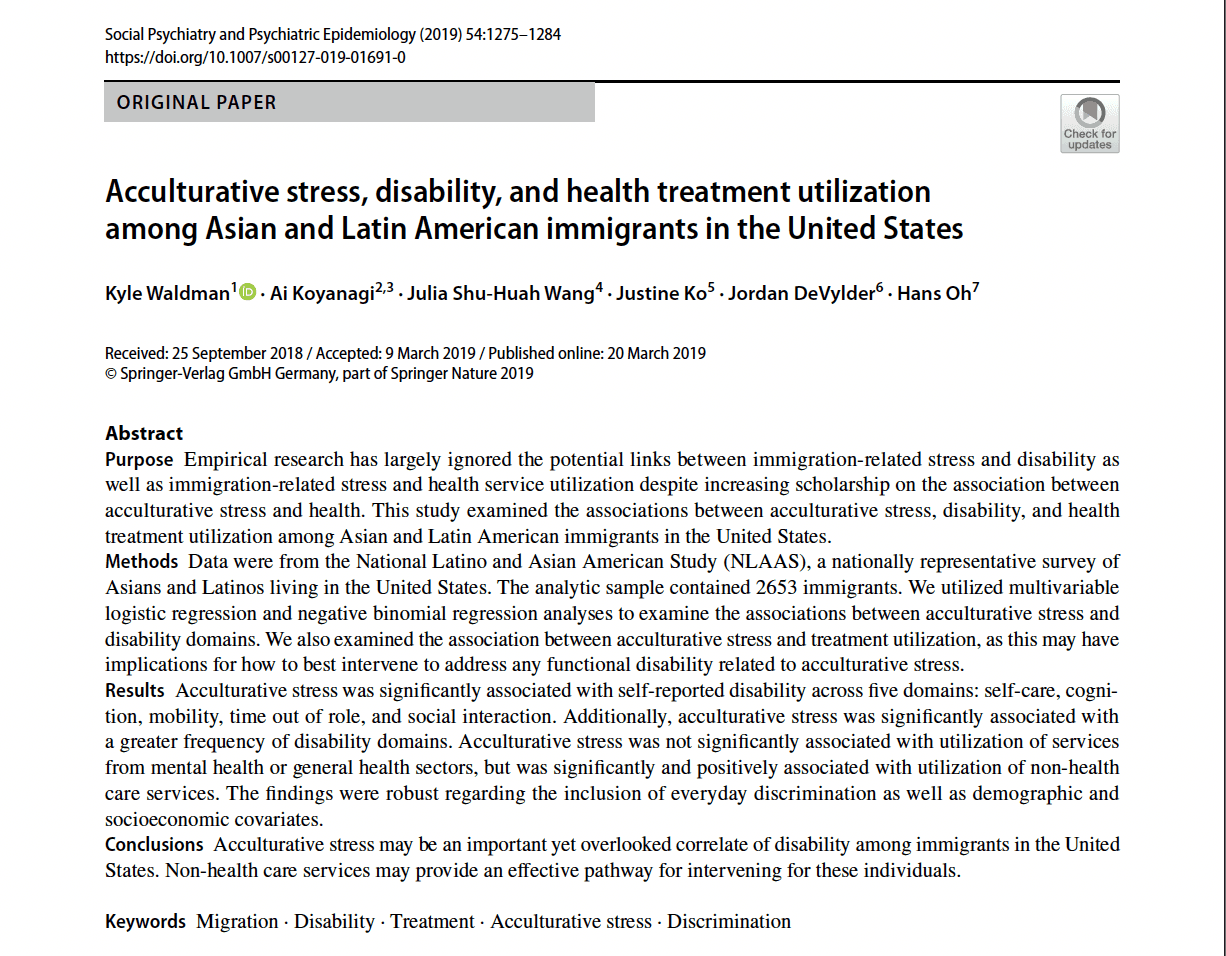
Before I began my PhD, I also published research focusing on health inequality within the U.S. I have first- or co-authored several peer reviewed articles on the health consequences of immigration- and ethnoracial-based stressors, focusing primarily on Latino and Asian populations. My health-related research can be found in Social Psychiatry and Psychiatric Epidemiology, Journal of Latinx Psychology, Public Health, and Journal of Immigrant and Minority Health, among other leading journals.
Selected Publications


Skills & Expertise

GET IN TOUCH
SOCIAL